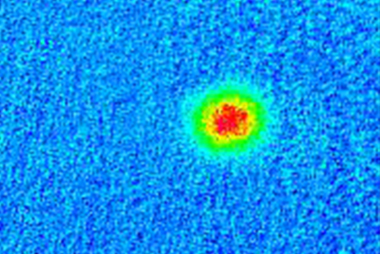
Atomic Bose–Einstein condensate in twisted-bilayer optical lattices
Authors:Zengming Meng, Liangwei Wang, Wei Han, Fangde Liu, Kai Wen, Chao Gao, Pengjun Wang, Cheng Chin, and Jing Zhang
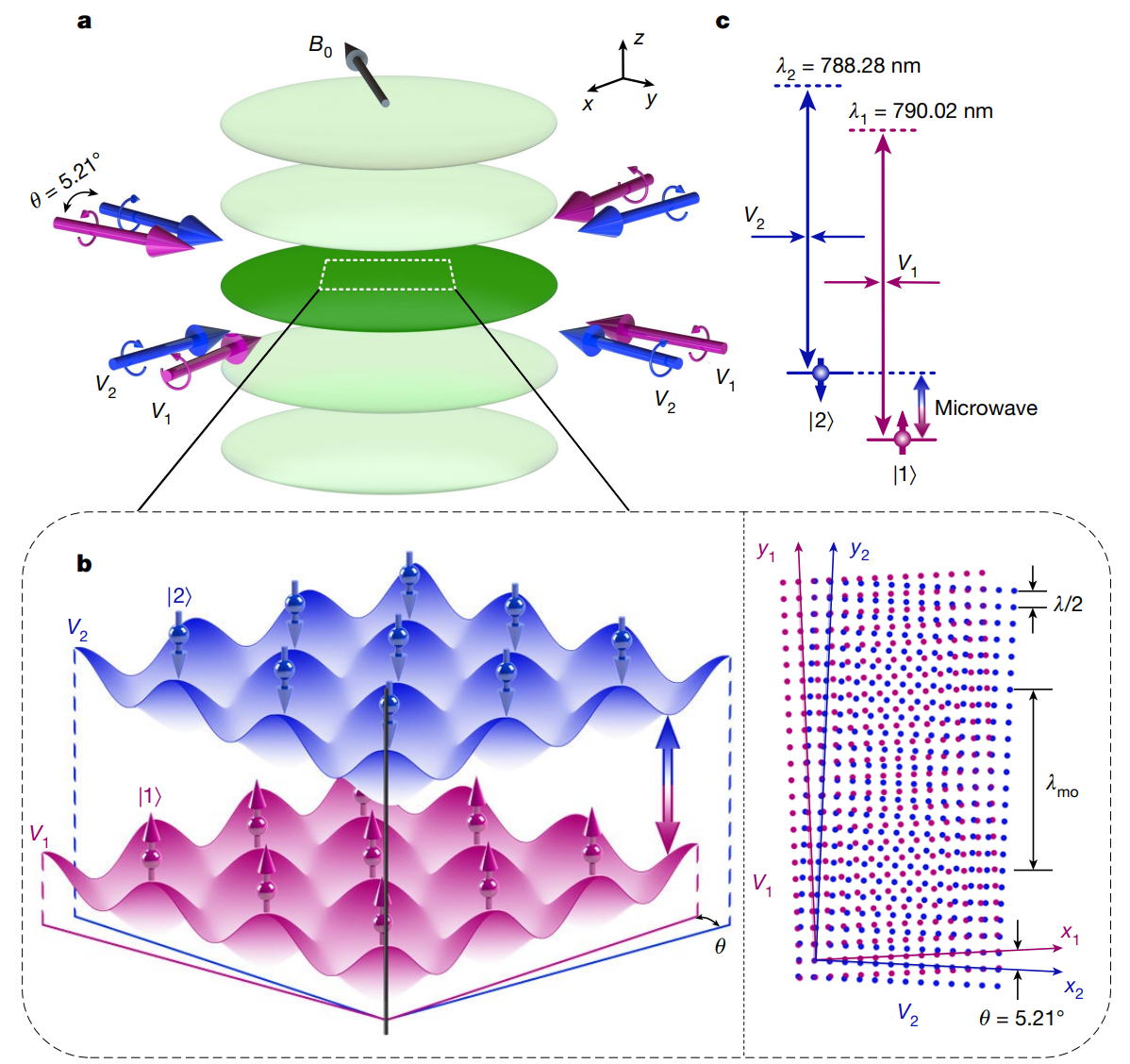
Observation of strong correlations and superconductivity in twisted-bilayer graphene has stimulated tremendous interest in fundamental and applied physics. In this system, the superposition of two twisted honeycomb lattices, generating a moiré pattern, is the key to the observed fat electronic bands, slow electron velocity and large density of states. Extension of the twisted-bilayer system to new confgurations is highly desired, which can provide exciting prospects to investigate twistronics beyond bilayer graphene. Here we demonstrate a quantum simulation of superfuid to Mott insulator transition in twisted-bilayer square lattices based on atomic Bose–Einstein condensates loaded into spin-dependent optical lattices. The lattices are made of two sets of laser beams that independently address atoms in diferent spin states, which form the synthetic dimension accommodating the two layers. The interlayer coupling is highly controllable by a microwave feld, which enables the occurrence of a lowest fat band and new correlated phases in the strong coupling limit. We directly observe the spatial moiré pattern and the momentum difraction, which confrm the presence of two forms of superfuid and a modifed superfuid to insulator transition in twisted-bilayer lattices. Our scheme is generic and can be applied to diferent lattice geometries and for both boson and fermion systems. This opens up a new direction for exploring moiré physics in ultracold atoms with highly controllable optical lattices.
Experimental study of tune-out wavelengths for spin-dependent optical lattice in 87Rb Bose–Einstein condensation
Authors:Kai Wen, Zengming Meng, Liangwei Wang, Liangchao Chen, Lianghui Huang, Pengjun Wang, and Jing Zhang
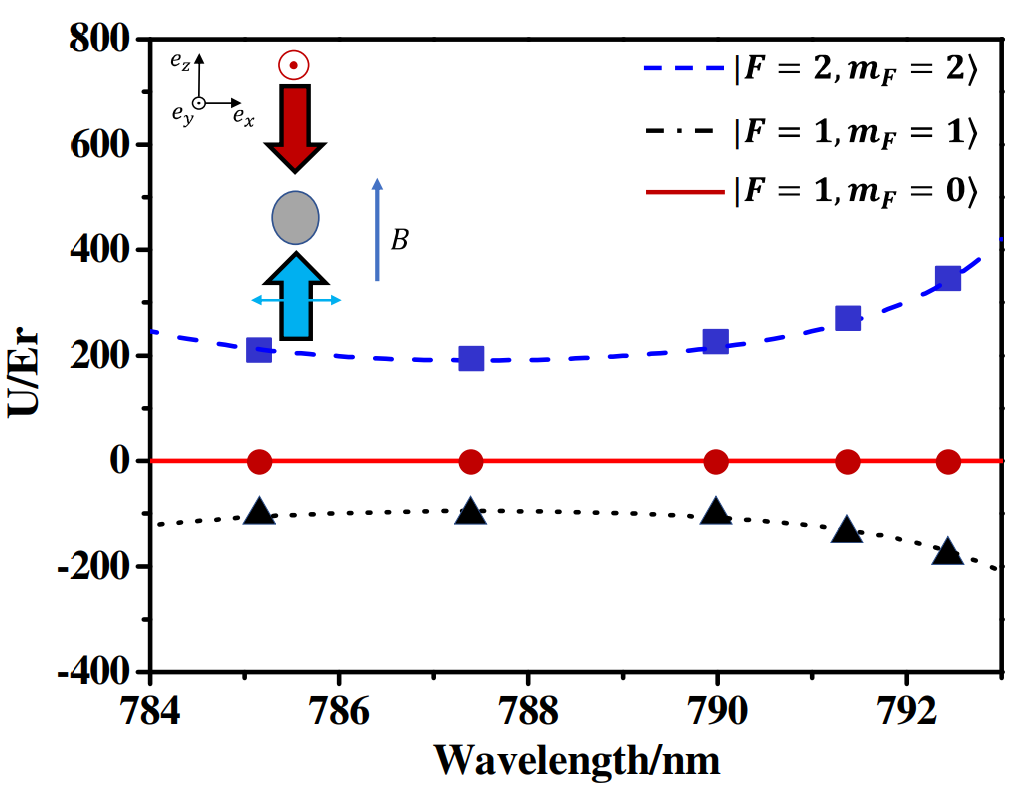
We study the periodic potential of a one-dimensional optical lattice originating from a scalar shift and vector shift by manipulating the lattice polarizations. The ac Stark shift of an optical lattice is measured by Kapitza–Dirac scattering of 87Rb Bose–Einstein condensate, and the characteristics of a spin-dependent optical lattice are presented by scanning the lattice wavelength between the D1 and D2 lines. At the same time, tune-out wavelengths that the ac Stark shift cancels can be probed by the optical lattice. We give the tune-out wavelengths in more general cases of balancing the contributions of both scalar and vector shifts. Our results provide a clear interpretation for a spin-dependent optical lattice and tune-out wavelengths, and help to design it by choosing the appropriate lattice wavelength....

Time-resolved interplay between superradiant and subradiant states in superradiance lattices of Bose-Einstein condensates
Authors:Chengdong Mi, Khan Sadiq Nawaz, Liangchao Chen, Pengjun Wang, Han Cai, Da-Wei Wang, Shi-Yao Zhu, and Jing Zhang
The collective spontaneous emission of many atoms is significantly different from that of a single atom, depending on the geometry and the phase correlation of atomic ensembles. However, experimental observation of arbitrary superradiant and subradiant states of atoms remains challenging due to the difficulties in both preparation and detection of those states. Here we report the time-resolved observation of superradiance from a timed Dicke state in a momentum-space superradiance lattice of Bose-Einstein condensates, which enables an in situ measurement of the coherent lattice dynamics involving both superradiant and subradiant states. The long-lasting oscillation in the superradiant emission is contributed by population transport from the subradiant states in the superradiance lattice. This work paves the way to prepare and observe subradiant states, which has promising applications in quantum information processing...
Production of 23Na Bose–Einstein condensates in the F = 2 state using D2 gray molasses
Authors:Zhenlian Shi, Ziliang Li, Pengjun Wang, Khan Sadiq Nawaz, Liangchao Chen, Zengming Meng, Lianghui Huang, and Jing Zhang
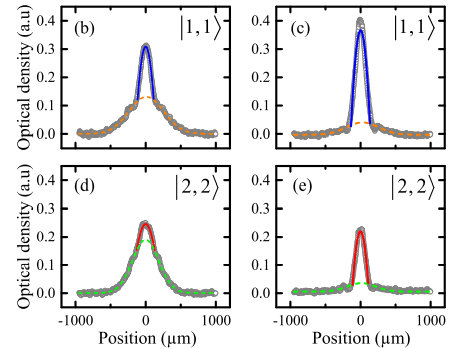
We report on the production of Bose–Einstein condensates of sodium atoms in the hyperfine state |F = 2, mF = 2〉 in a crossed optical dipole trap using D2 gray molasses.We use the gray molasses sub-Doppler cooling technique to obtain an atomic sample of 3 × 10⁸at 56 µK. After the radio frequency (RF) evaporation cooling in an optically plugged magnetic trap, we transfer the atoms sample of 2.5 × 10⁶at 5.7 µK to a crossed optical dipole trap where a pure condensate with an atom number of 2 × 10⁵and lifetime of 6.3 s is obtained by further evaporation. We compare the cooling process of sodium atoms in the |2, 2〉 and the |1, 1〉 states by evaporation in the optical trap, and also observe the different three-body loss rates by the lifetime measurement...

Rydberg excitation spectrum of 40K ultracold Fermi gases
Authors:Donghao Li, Guoqi Bian, Jie Miao, Pengjun Wang, Zengming Meng, Liangchao Chen, Lianghui Huang, and Jing Zhang
We report the measurement of the Rydberg excitation spectrum by two-photon process in ultracold 40K Fermi gases. Two different methods are employed to measure the Rydberg excitation spectrum, depending on the power of the probe laser. One scheme is to reduce atomic losses by means of electromagnetically induced transparency. The other is to enhance the atomic losses by spontaneous avalanche ionization due to the strong Rydberg-Rydberg interactions. We verify the consistency of both of the methods. The highest Rydberg states detectable in our experiment are limited to n ≤ 62 due to the competition between the long Rydberg blockade effective range and the limited atomic cloud size...
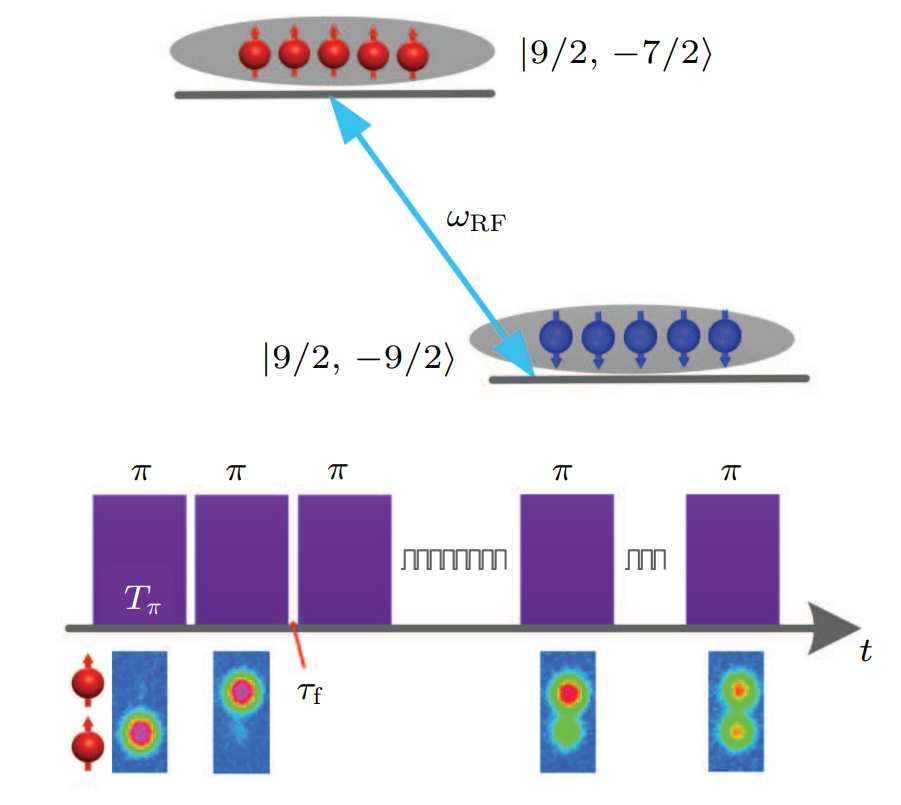
Preparation of a two-state mixture of ultracold fermionic atoms with balanced population subject to the unstable magnetic field∗
Authors:Donghao Li, Lianghui Huang, Guoqi Bian, Jie Miao, Liangchao Chen, Zengming Meng, Wei Han, and Pengjun Wang
We report a novel method to prepare a mixture of 40K Fermi gas having an equal population of the two ground magnetic spin states confined in an optical dipole trap, in the presence of an noisy quantization (magnetic) field. We realize the equal population mixture by applying a series of RF pulses. We observe the dependence of the population distribution between two spin states on the number of the applied RF pulses and find that the decoherence effects leading to the population fluctuations are overcome by the high number of RF pules. Our demonstrated technique can be potentially used in the precision measurement experiments with ultracold gases in noisy environments...
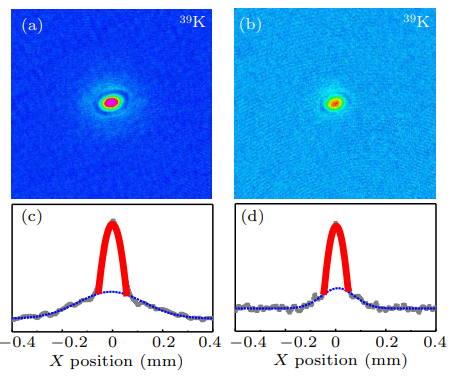
Production of dual species Bose–Einstein condensates of 39K and 87Rb∗
Authors:Cheng-Dong Mi, Khan Sadiq Nawaz, Peng-Jun Wang, Liang-Chao Chen, Zeng-Ming Meng, Lianghui Huang, and Jing Zhang
We report the production of 39K and 87Rb Bose–Einstein condensates (BECs) in the lowest hyperfine states |F = 1,mF = 1〉 simultaneously. We collect atoms in bright/dark magneto-optical traps (MOTs) of 39K/87Rb to overcome the light-assisted losses of 39K atoms. Gray molasses cooling on the D1 line of the 39K is used to effectively increase the phase density, which improves the loading efficiency of 39K into the quadrupole magnetic trap. Simultaneously, the normal molasses is employed for 87Rb. After the microwave evaporation cooling on 87Rb in the optically plugged magnetic trap, the atoms mixture is transferred to a crossed optical dipole trap, where the collisional properties of the two species in different combinations of the hyperfine states are studied. The dual species BECs of 39K and 87Rb are obtained by further evaporative cooling in an optical dipole trap at a magnetic field of 372.6 G with the background repulsive interspecies scattering length aKRb = 34a0 (a0 is the Bohr radius) and the intraspecies scattering length aK = 20.05a0...
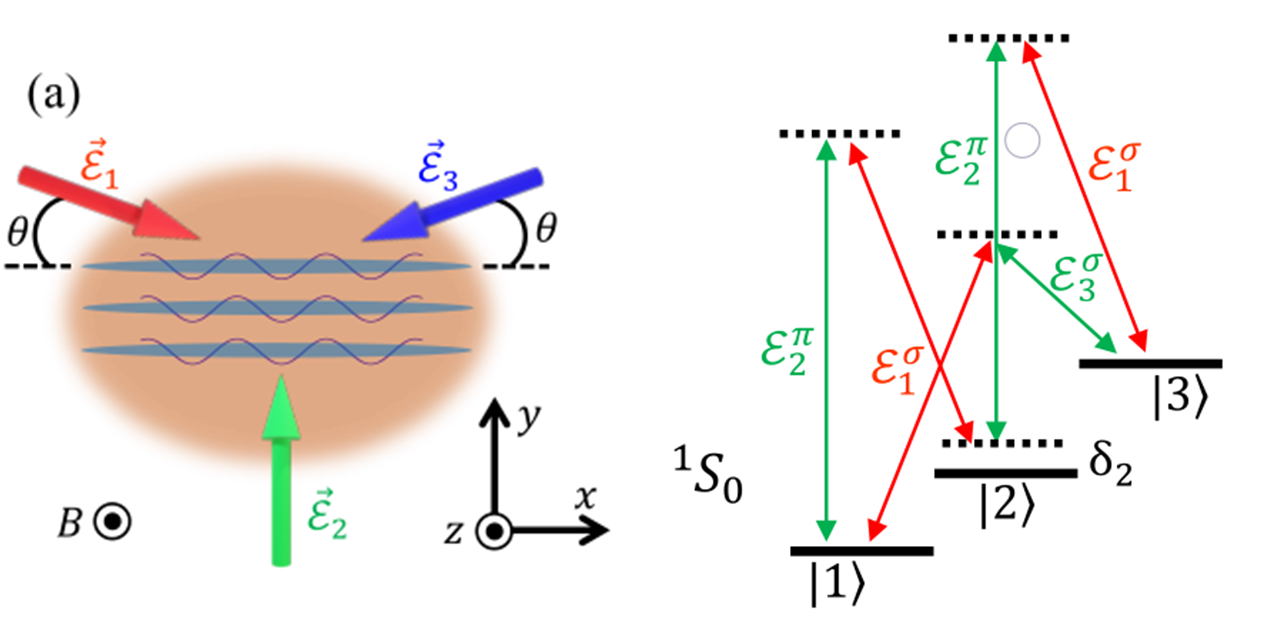
Tunable flux through a synthetic hall tube of neutral Fermions
Authors:Xi-Wang Luo, Jing Zhang, Chuanwei Zhang
Hall tube with a tunable flux is an important geometry for studying quantum Hall physics, but its experimental realization in real space is still challenging. Here, we propose to realize a synthetic Hall tube with tunable flux in a one-dimensional optical lattice with the synthetic ring dimension defined by atomic hyperfine states. We investigate the effects of the flux on the system topology and study its quench dynamics. Utilizing the tunable flux, we show how to realize topological charge pumping. Finally, we show that the recently observed....
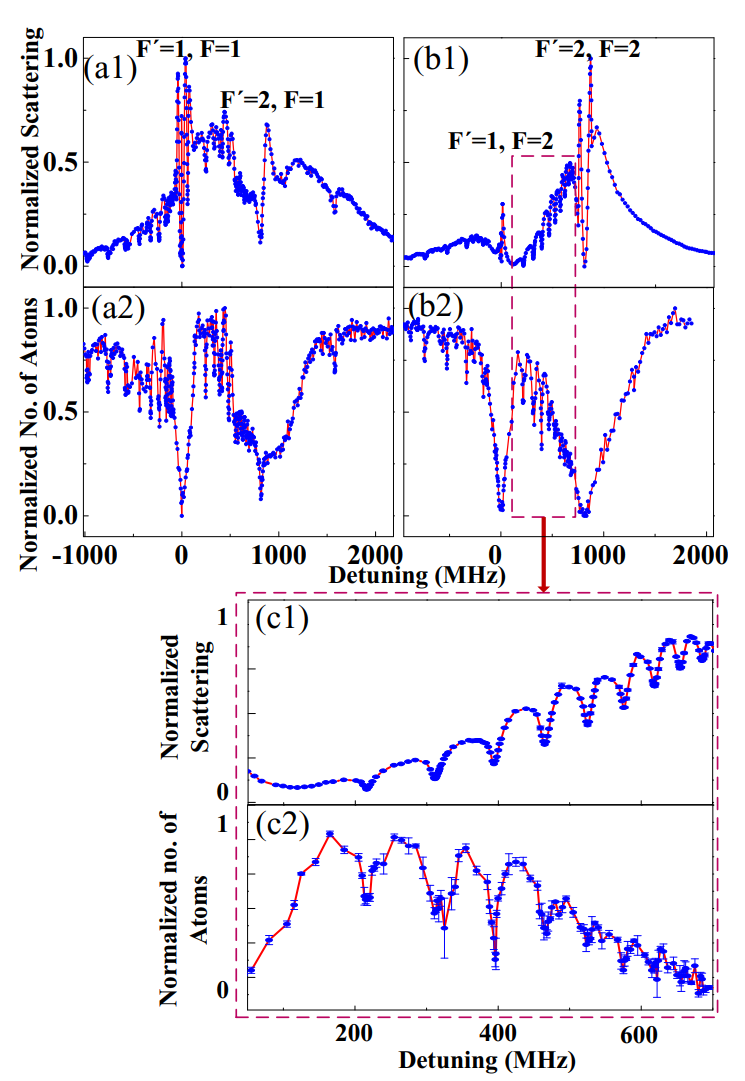
Photoassociation spectroscopy of weakly bound 87Rb2 molecules near the 5P1/2 + 5S1/2 threshold by optical Bragg scattering in Bose-Einstein
Authors:Khan Sadiq Nawaz, Liangchao Chen, Chengdong Mi, Zengming Meng, Lianghui Huang, Pengjun Wang , and Jing Zhang
We report the high-resolution photoassociation (PA) spectroscopy of a 87Rb Bose-Einstein condensate (BEC) to excited molecular states near the dissociation limit of 5P1/2 + 5S1/2 by optical Bragg scattering. Since the detection of optical Bragg scattering in the BEC has a high signal-noise ratio, we obtain the high-resolution PA spectrum of excited molecular states in the range of ±1 GHz near the dissociation limit of 5P1/2 + 5S1/2 . We compare the results with the conventional method of trap loss and show that the results agree with each other very well. Many interesting phenomena of excited molecular states are observed, such as light-induced frequency shift and anomalous strong bound molecular lines at the atomic transition from |F = 1> to |F'= 2>. The observed excited molecular states in the range of ±1 GHz near the dissociation limit of 5P1/2 + 5S1/2 should help to further improve long-range bound-state models near the dissociation limit....
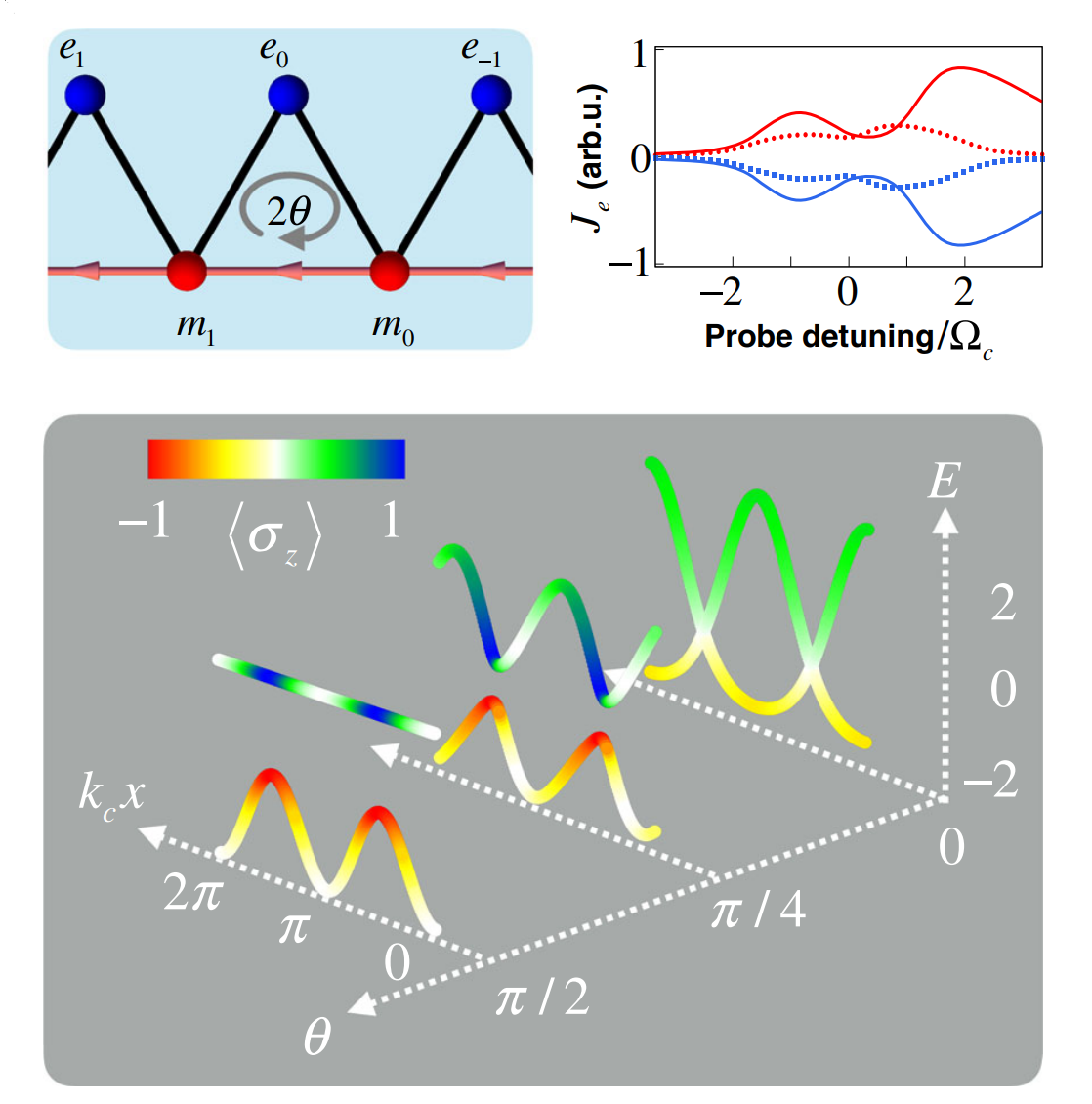
Synthesized magnetic field of a sawtooth superradiance lattice in Bose–Einstein condensates
Authors:Pengjun Wang , Liangchao Chen , Chengdong Mi , Zengming Meng , Lianghui Huang , Khan Sadiq Nawaz , Han Cai , Da-Wei Wang , Shi-Yao Zhu and Jing Zhang
Ultracold atoms have become one of the most exciting platforms to synthesize novel condensed matter physics. Here we realize a sawtooth superradiance lattice in Bose–Einstein condensates and investigate its chiral edge currents. Based on one-dimensional superradiance lattice (SL) in standing wave-coupled electromagnetically induced transparency, a far-detuned standing-wave field is introduced to synthesize a magnetic field. The relative spatial phase between the two standing-wave coupling fields introduce a magnetic flux in the sawtooth loop transitions of the lattice. This flux determines the moving direction of excitations created in the SL and results in nonsymmetric reflectivities when the SL is probed in two opposite directions. Our work demonstrates an in situ technique to synthesize and detect artificial gauge field in cold atoms...
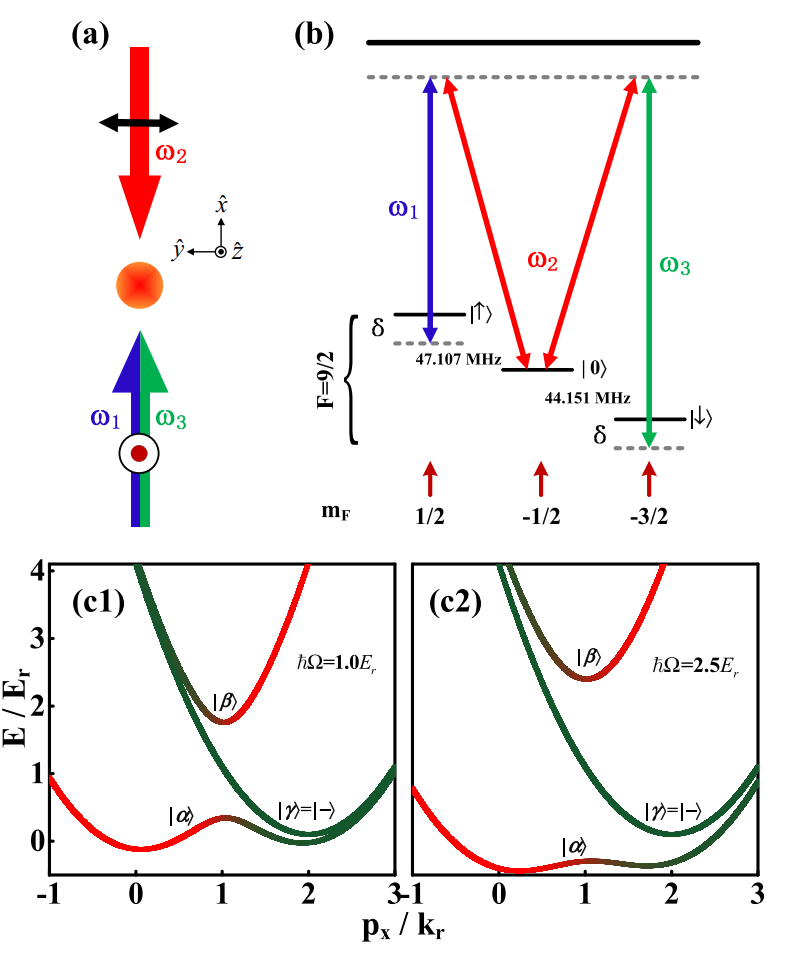
Experimental realization of spin-tensor momentum coupling in ultracold Fermi gases
Authors:Donghao Li , Lianghui Huang, Peng Peng, Guoqi Bian, Pengjun Wang, Zengming Meng, Liangchao Chen and Jing Zhang
We experimentally realize spin-tensor momentum coupling (STMC) using three ground Zeeman states coupled by three Raman laser beams in an ultracold atomic system of 40K Fermi atoms. This type of STMC consists of two bright-state bands as a spin-orbit coupled spin-1/2 system and one dark-state middle band. Using radio-frequency spin-injection spectroscopy, we investigate the energy band of STMC. It is demonstrated that the middle state is a dark state in the STMC system. The experimental realization of STMC open the door for further exploring exotic quantum matter...